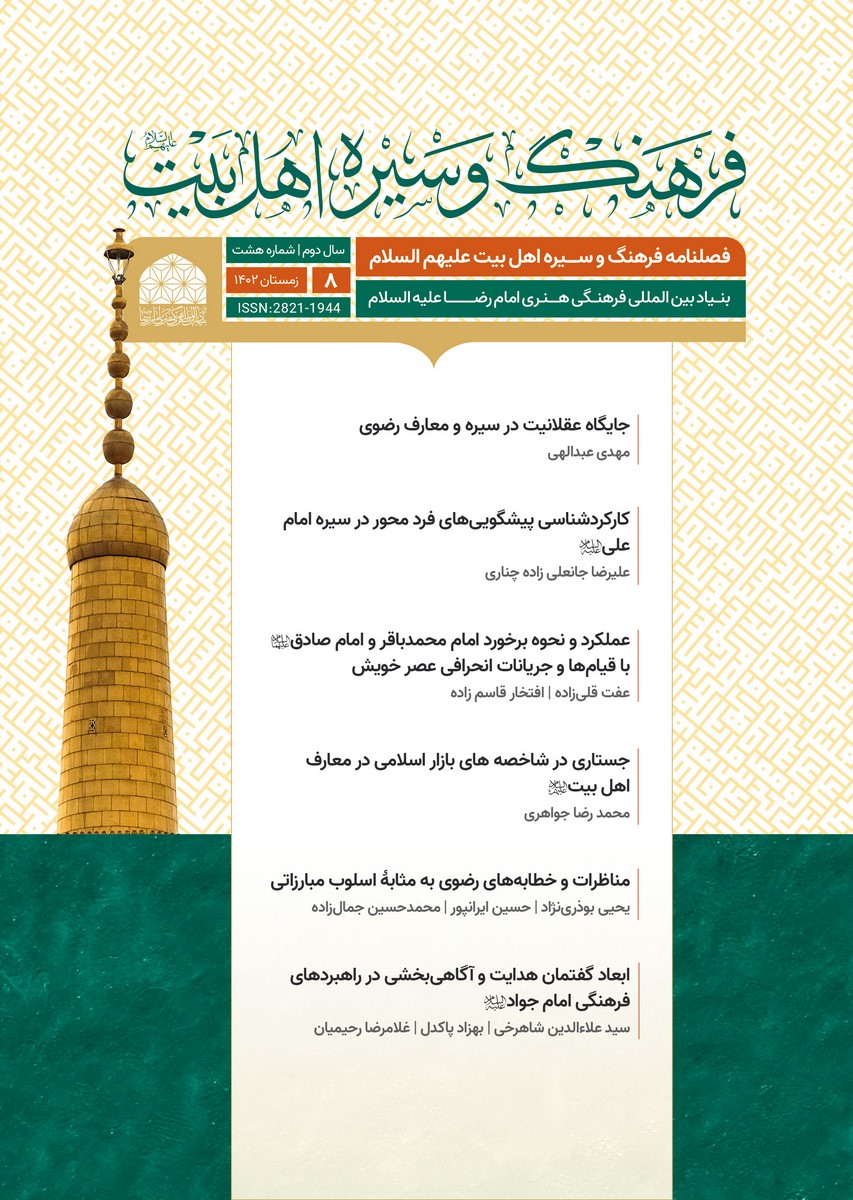


Call for articles for the quarterly "Maarif Ahl al-Bayt (AS)"

Please refer to this address: maarefahlalbayt.ir.

How to write a letter

(Dear authors! Please align it with the style sheet before uploading the article)

Receive the electronic version (ebook) of Farhang Razavi Quarterly **

Supporting university and seminary theses and dissertations related to Razavi culture and life (details)

Place of publication: Iran, Mashhad

Publisher: International Cultural and Artistic Foundation of Imam Reza (peace be upon him)

Year of publication: 1392

Specialized field: Imam Reza (peace be upon him)

Credit of the journal: scientific-research

(According to the new regulation of scientific publications, all publications included in this regulation will be known as scientific publications from now on)

Journal language: Bilingual; Persian,English

Publication date: Quarterly

Publication type: printed and electronic

Rank in the assessment of the Ministry of Science: b

Quality based on the Islamic World Science Citation Database index: Q2

The cost of reviewing and publishing the article: Yes

Type of arbitration: at least 2 referees, two-way anonymous electronic (see details)

Arbitration time: 2 to 3 months

Access to articles: free (full text)

Indexed: Yes (see details)

Similarity search: The articles uploaded in the system of the scientific-research quarterly "Farhang Razavi" are checked for similarity through a system similar to Yaab Simim Noor before being included in the judging process.


https://psas.ir  https://www.samimnoor.ir/view/fa/Default https://www.isc.ac/fa https://www.academia.edu https://www.noormags.ir/view/fa/default   https://civilica.com  https://www.magiran.com  https://library.basu.ac.ir/en     https://scholar.google.com

Cultural Transformation and Its Impacts on Razavi Culture: A Study Based on Grounded Theory

Cultural Transformation and Its Impacts on Razavi Culture: A Study Based on Grounded Theory

Pages 7-32

https://doi.org/10.22034/farzv.2024.478131.2036

Mahmoudreza Rahbarqazi, Zahra Sadeghi naghdali

Abstract Razavi Culture, rooted in the teachings of Imam Reza (A.S.) and the knowledge of the Ahl al-Bayt, is one of the most valuable aspects of Islamic and Shia culture, playing a crucial role in shaping the religious and social identity of Muslims, especially Shia. The importance of Razavi culture lies in the fact that distancing from it not only affects religious dimensions but can also have profound consequences in social, cultural, political, and identity-related areas. In this regard, this study aims to examine the causes and strategies behind the distancing from Razavi culture among some Iranian citizens and its consequences, analyzing the phenomenon from the perspective of cultural and religious theories.

For this purpose, the qualitative method and Strauss and Corbin's grounded theory approach were employed. The necessary data were collected from in-depth interviews with 25 individuals from different groups in the city of Tabriz. The results of the research indicate that the focused codes for causal conditions include factors such as social transformation, the decline of institutional legitimacy, secularism discourse, and cultural colonization. In the section on contextual conditions, structural economic crises, cultural pluralism, the collapse of the epistemic system, and instability in the family education system were identified as key contexts. The intervening codes refer to the role of ideological conflicts, a rupture in epistemic mediation, the haste in global integration, and the consumerist information market.

Finally, considering two strategies of acceptance and resistance by society, which were presented as individual reactions to this phenomenon, the consequences of distancing from Razavi culture manifested as a legitimacy crisis, nationalism and ethnocentrism, social-political divergence, decline in soft power, secularization of political discourse, collapse of normative order, identity vacuum, erosion of social solidarity, identity entropy, and disintegration of the educational structure.


The role of the architectural arrays of the shrine of Imam Reza (AS) in explaining monotheism with an emphasis on decorations

The role of the architectural arrays of the shrine of Imam Reza (AS) in explaining monotheism with an emphasis on decorations

Pages 33-61

https://doi.org/10.22034/farzv.2025.483421.2040

khorshid Mahdavi, ZeinabosSadat Hosseini

Abstract معماری اسلامی و تزیینات وابسته به آن با توجه به حجم و زمان ماندگاری نسبت به هنرهای اسلامی دیگر از اهمیت خاصی در بین هنرهای اسلامی برخوردارند. انواع هنرهایمعماری اسلامی و تزیینات وابسته به آن با توجه به حجم و زمان ماندگاری، نسبت به هنرهای اسلامی دیگر، از اهمیت خاصی در بین هنرهای اسلامی برخوردار می باشند. انواع هنرهای بصری اسلامی اعم از طراحی، خوشنویسی، آینه -کاری، گچ ‌کاری و ... در معماری و تزیینات وابسته به آن در اماکن مذهبی قابل مشاهده ‌است که نقش موثری در بیان اصول دین اسلام از جمله توحید دارند. از جمله موارد آن، تزیینات به‌ کار رفته در حرم رضوی است که چگونگی ارتباط آن با مفهوم توحید و تأثیرگذاری آنها بر اعتقادات مخاطبان مسئله شایسته پژوهش است. این پژوهش با روش توصیفی - تحلیلی و تصاویر میدانی به بررسی ارتباط تزیینات در معماری حرم رضوی بر تقویت اصل توحید در اعتقادات مخاطبان پرداخته ‌است. نتایج پژوهش حاکی از این است که تزیینات موجود در حرم رضوی در نمای خارجی، حیاط، گلدسته ها، آینه کاری، ستون ها، گنبد، کتیبه ها، گچ بری، علاوه بر زیبایی ظاهری برای هر زائر عامی و خواص، دارای زیبایی درونی می‌باشد که مطابق با فطرت انسانی می‌باشد و انسان مسلمان با دیدن تزیینات حس خوشایند درونی را تجربه می ‌کند و خواهان این تجربه شیرین به دفعات می‌‌ باشد. طر‌ح‌ها و نقش ‌های اسلامی که در معماری بناهای اسلامی جلوه‌ گری می‌کنند با زبان اشاره‌ها با مخاطبان ارتباط برقرار می‌کنند و هر مخاطبی با توجه به خودسازی و آمادگی درونی خویش که از قبل در خود ایجاد کرده‌است؛ رمز و رازهای هنر اسلامی که مهم‌ترین آن ‌ها روح توحید و یگانگی می ‌باشد را به تدریج درک می‌ کند.

The wise moderation of the pervasive theme in the pattern of encountering the pretending agent in Razavis life.

The wise moderation of the pervasive theme in the pattern of encountering the pretending agent in Razavi's life.

Pages 63-92

https://doi.org/10.22034/farzv.2025.493259.2052

mohammad reza anvari

Abstract "Pretending" is a social harm that, although it is also felt in communications between ordinary people in society, recognizing pretense and correctly confronting a pretender who is in government positions is much more complex and difficult due to the various sources of power. In this article, pretense is considered as a "cultural-communicational harm" and the goal is to explain the pattern of Imam Reza's confrontation with Ma'mun as a pretender who is in the highest ranks of the government. To achieve this pattern, the method of text hermeneutics with an "interrogative and author-centered" approach and content analysis were used to collect data from the narrations and life of Imam Reza and to analyze the data. By examining the lexical meaning of the word "tolerance" and carefully examining the narrations in this field and applying it to the life of Imam Reza, as well as analyzing the content of Imam Reza's verbal and non-verbal actions, 44 basic themes, 6 organizing themes, and one comprehensive theme were obtained. “Foresightful tolerance”, “measurement in actions”, “exposing pretense while tolerating the pretense”, “benevolence and observing expediency”, “observing Islamic principles”, and “strict confrontation in case of ineffective tolerance” are 6 organizing themes that are placed under “wise tolerance” as a comprehensive theme. “wise tolerance” should be considered as a communication principle in confronting pretense. The wise attribute of the spirit is the governing tolerance in confronting the pretense. In fact, tolerance is done with the pretense person, not with his pretense. It is suggested that the model of confronting pretense agents in the current situation be the subject of another article and that by updating the model obtained from this article, the current model of confronting pretense can be drawn.

Examining the ideal history of Shiism until the time of Imam Reza (AS) with an emphasis on the emergence of the Waqifah sect

Examining the ideal history of Shiism until the time of Imam Reza (AS) with an emphasis on the emergence of the Waqifah sect

Pages 93-124

https://doi.org/10.22034/farzv.2025.496674.2062

reza valipoor

Abstract کاربست رویکرد تاریخ انگاره در کنار رویکردهای تاریخ اجتماعی ،تاریخ فرهنگی،تاریخ تمدن و...در مطالعه منابع اسلامی ، ضمن پدیدآیی افق های جدید در شناخت منابع ، موجب ارائه برخی گزاره های ناهمخوان با باورهای مذاهب اسلامی گشته است.استفاده از این رویکرد ضمن ایجاد خودآگاهی نسبت به پارادایم درون دینی ، تعامل با پارادیم های جدید را فراهم می سازد. فرقه واقفه یکی از چالش برانگیزترین موضوعات امامیه به دلیل گستردگی روایات مرتبط با آن و ناکافی بودن ساختارهای سنتی علومِ فرق شناسی و رجال ، فهم و تحلیل آن را در چارچوب های کلیشه ای قرار داده که برای توصیف و بیان چرایی رفتار شیعیان امامیه ناکافی می باشد. کاربست رویکرد تاریخ انگاره ای با تعاریف منقح ، ظرفیت های جدیدی برای توصیف و تبیین افتراق درونی جریان شیعه در آن مقطع تاریخی فراهم ساخته و امکان پاسخگویی به از برخی نتایج ناشی از رویکردهای تاریخی را میسر می سازد. طرحواره ای که با بررسی تاریخ انگاره های امامیه استخراج می شود ، جریان شیعه امامیه در دوران حیات ائمه (ع) در بستر کوفه و شرایط دشوار تاریخی در عین التزام بر اصول معین ، پیرامون اصولی درحال آزمون و تحقیق بوده و تطبیق برخی انگاره ها ،امکان بروز رفتارهای مختلف را محتمل می ساخت.شرایط بحرانی حبس و درگذشت مبهم امام کاظم (ع) ، موجب تنش شدید انگاره ای درون امامیه و در ارتباط با دیگر جریان ها بر محور برخی از انگاره های مألوف امامیه و هویت یابی جریان هایی از توقف کنندگان در حالت های : قطعیت امامتِ امام رضا(ع)، توقف در شک نسبت به امامت امام رضا(ع) یا درگذشت امام کاظم(ع) ، غلو ، تاویل و تطبیق تأویل انگاره های غیبت و قائمیت گردید. واقفه تاویل گر با تاویل برخی روایات و اصرار بر آن و گسست انگاره ای از امامیه ، مذهب واقفی را پدید آوردند.

Analysis of Lexical and Conjunctive Cohesion in Imam Rezas Sermon on Divine Unity with Emphasis on Halliday and Ruqaiya Hasans Text Cohesion Theory

Analysis of Lexical and Conjunctive Cohesion in Imam Reza's Sermon on Divine Unity with Emphasis on Halliday and Ruqaiya Hasan's Text Cohesion Theory

Pages 125-155

https://doi.org/10.22034/farzv.2025.496166.2061

FATEMEH MOLAYEM

Abstract Cohesion is a fundamental concept in linguistics that examines the factors of connectivity and relationships between sentence components, inter-sentential relations, and the overall text structure. This term, introduced by functional linguists in the field of discourse analysis, comprehensively studies the role of cohesive components in text formation and organization. Imam Reza's (PBUH) monotheistic sermon is a religious text with profound monotheistic content and literary richness, in which the Imam (PBUH) has artfully and intelligently utilized cohesive elements to create a coherent and systematic structure. This research uses the bases of Halliday and Ruqaiya Hasan's textual cohesion theory to examine the conjunctive and lexical cohesion factors of this sermon. The present study, while analyzing conjunctive, lexical, and rhetorical cohesive components, systematically examines the interdiscursive relations and the role of these elements in the sermon's structure and the transmission of philosophical concepts. The research findings indicate that among the conjunctive elements, the additive conjunction "and" has the highest frequency in the text, and at the lexical level, the Imam (PBUH) has artistically employed various lexical cohesion elements such as antonymy, opposition, and semantic fields. These lexical elements, formed based on syntagmatic relations in the speech chain, have played a more prominent and influential role in creating textual cohesion. The results of this research clearly demonstrate that using Halliday and Hasan's cohesion theory, while identifying cohesive elements in religious texts, one can scientifically and methodically explain how these elements influence text formation and the clear, unambiguous transmission of profound philosophical and religious concepts.

Functional analysis of Imam Rezas debates against Mamoon identity threats

Functional analysis of Imam Reza's debates against Mamoon identity threats

Pages 179-216

https://doi.org/10.22034/farzv.2025.476588.2035

mohsen fekrifallah, Amirmohsen erfan, Seyyed Ruhollah Parhishkari

Abstract Correct debate and good argument, as a place for ideas to meet, due to the combination of two aspects, positive-affirmative and negative-other, has a direct and deep connection with the identity structure of the individual, group and society, and is able to play an important role in defining the boundaries to play an identity On the other hand, it is necessary to pass from the reductionist approaches to the investigation of the life of the Ahl al-Bayt (AS) and to review and rewrite it with the aim of knowingly understanding their identity-building life as a model for creating the present and the future in the Islamic society. The mission of this study is to answer the question that Imam Reza's (pbuh) debates, with the aim of reaching the dimensions and identity-building aspects of Imam Reza's (a.s.) debates, were created in the face of the identity threats created by the false front, whose prominent symbol in that era was the Abbasid caliphate. What was its effect and the functions of what it was. Based on this, the functions of the Prophet's debates are divided into three areas: determining, distinguishing and protecting. The maximum monitoring of issues, questions and doubts and the presentation of various evidences and documents from internal and other sources in the debates, not only led to the establishment and determination of the Shiite identity and its distinction from non-identities, but its epistemological resolution guaranteed the identity security for the Shiite discourse.Based on the teachings of religion, it can be used as a strategy for the identification of individuals and societies.

An examination of the news attributed to Imam Reza (AS) indicating that divine power is involved in impossible matters

An examination of the news attributed to Imam Reza (AS) indicating that divine power is involved in impossible matters

Articles in Press, Accepted Manuscript, Available Online from 31 January 2026

https://doi.org/10.22034/farzv.2025.494121.2056

Ebrahim Noei, seyyed Hosein seyyed ebrahimi

Abstract Believers believe in the guidance of reason and in the explicitness of the Quran and traditions that God has the power to accomplish everything. Their belief has faced a challenge of this kind: does this belief even include impossible things (such as the heavens and the earth and what is between them being swallowed in a seed)? The issuance of which requires the occurrence of things such as the placement of large objects in small objects. At different times, numerous people (Iblis, Abu Shakir Disani, etc.) have asked this question of Jesus Christ, Imam Ali, Imam Sadiq, and Imam Reza (peace be upon them). In one of these narrations, which Ibn Babawayh attributed to Imam Reza (AS) in his book Al-Tawhid, the Imam explicitly gave a positive answer to this question (inherent possibility) and emphasized its occurrence (in the form of an analogy of the reflection of the form of large objects in the eye). The present article seeks to examine this statement and its attribution to Imam Reza (AS) and, in the first step, attempts to examine its chain of transmission and meaning.
In the second step, he shows evidence from the Quran and narrations that confirm it. In the third step, this article highlights the challenges that we will face if we adhere to and accept this narration. (Incompatibility with the obvious rule of reason, conflict with numerous narrations, etc.) and in the last step, it tries to provide an aspect (such as the Imam's response relying on the weakness of the questioner's understanding) for the possibility of accepting this news and the possibility of its issuance by Imam Reza (AS).

The foundations of strengthening the family institution in religious teachings
Based on the hadiths of Imam Reza (a.s.)

The foundations of strengthening the family institution in religious teachings Based on the hadiths of Imam Reza (a.s.)

Articles in Press, Accepted Manuscript, Available Online from 25 October 2023

https://doi.org/10.22034/farzv.2022.352453.1788

Fatemeh Seyfaliei

Abstract This research is written with the aim of determining and explaining the foundations of strengthening the family institution in the teachings of the Quran and Hadith and in an analytical-descriptive method, and it states that these foundations can be investigated in the verses of the Quran and the traditions of the Ahl al-Bayt (PBUH) in the two periods before and after marriage. . Since the main pillars of the family are the man and the woman, choosing a worthy spouse before marriage is the most important principle in strengthening the family institution. If the choice of a spouse is made wisely and based on stable principles, then the first step in strengthening the family institution has been taken. The most important principles for choosing a spouse; Being equal in dignity, religion, morals, and the originality of the couple's family. After marriage, good association, moderation and moderation in all stages of life, expression of love and affection, patience in problems and forgiveness of mistakes, knowing each other and mutual understanding and placing justice and fairness in relationships are the most important foundations of strengthening the family institution. They form The result is that careful selection before marriage and good and pleasant morals and good socializing after marriage are the most important factors that can build a strong and stable tent and protect the foundation of the family from possible harm and damage.

Jurisprudential correlation analysis of Razavis narrative Al-Nasihah Khashna with evidences indicating the obligation of enjoining good and forbidding evil.

Jurisprudential correlation analysis of Razavi's narrative "Al-Nasihah Khashna" with evidences indicating the obligation of enjoining good and forbidding evil.

Articles in Press, Accepted Manuscript, Available Online from 23 December 2024

https://doi.org/10.22034/farzv.2024.404662.1889

alborz mohaghegh garfami, sayyed mahmoud marvian hussaini, mostafa hosini

Abstract One of the fundamental duties of Islam is enjoining good and forbidding evil. The appearance of some narrative evidence indicates the necessity of this obligation. On the other hand, there are narrations that list the limitations for the establishment of obligation. Zahir, one of the narrations transmitted by Imam Reza (a.s.) is a guide to the unworthiness of giving advice because it is unfortunate for the audience. This essay is based on a descriptive-analytical method in order to assess the correlation of this hadith with the guiding evidences on the duty of commanding what is good and forbidding what is bad. In order to achieve this goal, the possible reasons for the Imam's refusal to give advice have been highlighted and criticized as follows: the advice is seditious, it is not effective in the audience, the advice is instructive, and the obnoxious action in question is not included in the level of negation. In the last step, with the benefit of the significance analysis of the evidences showing the conditions for the obligation of this obligation in the field of being effective, as well as the guiding traditions on the conditions of effective advice, the selected point of view has been organized. The evaluation of the research is that relying on some historical documents and jurisprudential evidences, it is necessary that the narration is related to things that there is certainty about the ineffectiveness of admonition.

Identifying the dimensions and components of marketing strategies and explaining their relationships through a causal cognitive mapping approach at the Institute of Artistic Creations of Astan Quds Razavi

Identifying the dimensions and components of marketing strategies and explaining their relationships through a causal cognitive mapping approach at the Institute of Artistic Creations of Astan Quds Razavi

Articles in Press, Accepted Manuscript, Available Online from 05 April 2025

https://doi.org/10.22034/farzv.2025.504102.2071

Nafiseh Ebrahimnezhad, Seyed morteza Ghayour baghbani, Morteza Rojuee, saeed jafari titkanloo

Abstract Abstract
Cultural and artistic industries, due to their impact on cultural identity and their crucial role in the creative economy, require effective marketing strategies. Despite the significance of this field, limited research has focused on identifying the dimensions and components of marketing strategies in these industries. Therefore, the main question of this study is: What are the dimensions and components of marketing strategies in the Astan Quds Razavi Institute of Artistic Creations, and how are the relationships between these dimensions structured. This qualitative research was conducted using thematic analysis through coding and causal cognitive mapping with the UCINET software. In the first phase, a review of relevant academic articles from the past ten years was conducted, leading to the selection of 60 articles. Then, in-depth interviews were conducted with eight experts from the institute using purposive sampling. Finally, causal cognitive mapping was employed to explain the relationships among the identified components.The findings revealed a total of 170 basic themes and 40 organizing themes. The marketing strategies at the Astan Quds Razavi Institute of Artistic Creations encompass seven overarching themes: environmental analysis, market segmentation, positioning, targeting, product, pricing, and advertising. Additionally, the relationships among these variables indicate that marketing strategy dimensions are not only significant independently but also interact dynamically, forming a comprehensive and interconnected system. Among them, targeting and environmental analysis have the greatest impact.The proposed model can serve as an effective tool for enhancing marketing efforts in cultural and artistic industries, strengthening the institute’s competitive position in the market.

Representation of Symbols Associated with Imam Reza (A.S.) in Seven Paintings Preserved in the Museum of Reverse Glass Painting in Tehran

"Representation of Symbols Associated with Imam Reza (A.S.) in Seven Paintings Preserved in the Museum of Reverse Glass Painting in Tehran"

Articles in Press, Accepted Manuscript, Available Online from 28 October 2025

https://doi.org/10.22034/farzv.2025.539772.2099

Elaheh Panjehbashi, Negar Najibi

Abstract Reverse glass painting, as an ancient genre in Islamic art of Iran, with its unique combination of color and transparency, has served as a medium for narrating stories and conveying religious concepts within the Shiite context. In this regard, the representation of miracles and symbols associated with Imam Reza in reverse glass paintings holds particular significance. The artworks preserved in the Museum of Reverse Glass Painting in Tehran reflect diverse manifestations of such symbolic imagery in the form of halos of light, sacred footprints (Qadamgah), and animal motifs.
The aim of this study is to analyze the visual and semantic structures of symbols attributed to Imam Reza (A.S.) in seven selected paintings from the museum. The central research question asks: What symbolic reflections of Imam Reza are identifiable in the composition, color palette, and arrangement of animal and spatial elements in these artworks?
The research method is qualitative and follows a descriptive-analytical approach. Data were collected through library research and field observation, and analyzed using a semiotic-symbolic framework, focusing on the themes of “The Guardian of the Deer” (Zāmen-e Āhū) and the event of Imam Reza’s poisoning.
Findings reveal that the artists, through symmetrical arrangement of elements, symbolic use of colors, and the employment of halos and animal signs such as deer, camel, and wolf, reinforce concepts such as intercession, mercy, the contrast between sanctity and worldly threats, and the transcendence of time and space.
The convergence in visual structure alongside qualitative differences in execution highlights the variety of narrative techniques and emphasizes multiple layers of meaning.
Analyzing these symbols not only unveils the depth of meaning in the artworks but also facilitates understanding the cultural and religious significance of reverse glass painting in conveying Shiite teachings, particularly in relation to the lofty status and character of Imam Reza .

Prohibition of non-Muslim entry to the shrine of Imam Reza from the point of view of travel writers in the 13th and 14th centuries (A.H.)

Prohibition of non-Muslim entry to the shrine of Imam Reza from the point of view of travel writers in the 13th and 14th centuries (A.H.)

Articles in Press, Accepted Manuscript, Available Online from 10 November 2025

https://doi.org/10.22034/farzv.2025.507039.2076

Hamid reza Attariyani, Mahbouba Mahbouba, Hassan Shadpour

Abstract Throughout history, European travel writers and tourists interested in visiting the Razavi Shrine often traveled to Mashhad without knowing the specific rules of the Razavi Shrine and its sanctuaries. During their travels, tourists would ask their Muslim companions, who were on their way to visit the Shrine, They rarely mentioned in their travelogues any reports of their fellow travelers not being accepted, or any complaints or grievances about the regulations for travelers in pilgrimage caravans. However, when they arrived in Mashhad, based on their goals, which were mostly to tour and visit the historical complex of the Holy Shrine, They would encounter an unexpected challenge that would make them tired of the journey. Preventing non-Muslims from visiting the Holy Shrine was a problem during the Qajar and Pahlavi eras, which made European tourists very reluctant to travel to Mashhad. The research method in this study is quantitative and qualitative with a descriptive approach based on events taken from European travelogues in the 13th and 14th centuries AH. This research seeks to find the answer to the question: What measures or reactions did non-Muslim travel writers have in order to create a ban on the Holy Shrine? This research seeks to find the answer to the question: What measures or reactions did non-Muslim travel writers have in order to create a ban on the Holy Shrine? The findings of this study indicate that a large number of them were subject to the legitimate laws and current regulations of the Holy Shrine and public opinion. Therefore, after understanding the limitations, they preferred not to even approach the sanctum sanctorum. Some people also entered the shrine of Imam Reza through legal channels and influence, and a few people have also visited or reported on the holy shrine using subtle tricks and special tricks.

The Function of Ziyarat-Neshan and Imam Reza (AS) Birth Coins at Astan Quds Razavi from the Late Qajar Period to the Islamic Revolution

The Function of Ziyarat-Neshan and Imam Reza (AS) Birth Coins at Astan Quds Razavi from the Late Qajar Period to the Islamic Revolution

Articles in Press, Accepted Manuscript, Available Online from 17 November 2025

https://doi.org/10.22034/farzv.2025.518701.2083

ali najafzadeh, samane sadeqi

Abstract Coins, as valuable material objects, possess various cultural functions beyond their economic role. Due to these cultural functions, from the late Qajar period, coins known as Ziyarat-Neshan were minted in Mashhad. Additionally, starting in 1950 CE (1328 SH), Astan Quds Razavi minted Imam Reza (AS) Birth Coins for use in religious ceremonies, which became a cultural symbol. Over time, these birth coins gained diverse functions within this significant endowment and were minted and widely used over three decades. No prior research has explored the functions of Ziyarat-Neshan and Imam Reza (AS) Birth Coins. Thus, this article addresses the key question: What functions did Ziyarat-Neshan and Imam Reza (AS) Birth Coins serve at Astan Quds Razavi? This historical study, conducted through library-based research using Astan Quds Razavi documents and Mashhad-printed newspapers, reveals that the newly minted coins, known as Ziyarat-Neshan in Mashhad and Imam Reza (AS) Birth Coins in Tehran, served multiple functions within this major endowment. They were distributed as gifts to guests on occasions such as Imam Reza’s (AS) birth anniversary, Imam Hussein’s (AS) birth anniversary, and Nowruz. Moreover, they were presented as blessed tokens to notable domestic figures such as athletes, ministers, courtiers, and foreign dignitaries—including presidents, ministers, their entourages, and other prominent pilgrims—participating in the shrine’s dust-clearing ceremonies. Additionally, a significant portion of the Imam Reza (AS) Birth Coins, due to their spiritual significance, were sold as blessed items in the Astan Quds Razavi Museum.
1 3 - 4 6 8 9 4 7 9 7 5 34 ----------------- ---------

Comparative Analysis of the Components Providing Immunity Against Social Seditions in the Lives of Imam Ali and Imam Reza

Comparative Analysis of the Components Providing Immunity Against Social Seditions in the Lives of Imam Ali and Imam Reza

Articles in Press, Accepted Manuscript, Available Online from 12 May 2026

https://doi.org/10.22034/farzv.2026.570204.2126

masume ghazizadeh, Mohammad Marefat, Farahnaz Rafatjoo

Abstract One of the fundamental challenges in Islamic societies is the emergence of sedition, which threatens their security and social cohesion by creating an atmosphere of doubt and mixing truth with falsehood, and leads to the distortion of the religious and social foundations of the society's individuals. Given the importance of this issue, in order to achieve a society immune to sedition, it seems essential to recognize the components that provide immunity in dealing with them. The infallible Imams, especially Imam Ali and Imam Reza, have repeatedly described seditions and their consequences and have expressed effective solutions for dealing with seditions. This research aims to identify the immunity-giving components in the lives of these two Imams and to design a practical model for dealing with contemporary seditions. For this purpose, using a descriptive-analytical method and relying on Quranic verses and reliable narrational sources, the speeches of Amir al-Mu'minin and Imam Reza were examined in terms of immunity-giving components And a practical model for dealing with contemporary seditions is presented. The findings indicate that, in addition to common components such as adherence to the Quran, piety, insight, and patience, Imam Ali's life is focused on principles such as the implementation of justice, unity, and Imam Reza's life is focused on debates, educating a scientific generation, and taqiyyah. The research achievement is the extraction of a "sedition cycle management model" in four stages: prevention, detection, confrontation, and repair, which is presented as a three-level operational framework (individual, social, structural) for building immunity against contemporary seditions.This model can serve as a roadmap for cultural and social institutions in intelligently confronting the seditions of the present era.

Phenomenological Analysis of the Graves of Scholars Buried in the Shrines of the Ahl al-Bayt: Case Study: Shrine of Imam Reza (AS) and Hazrat Masoumeh (SA)

Phenomenological Analysis of the Graves of Scholars Buried in the Shrines of the Ahl al-Bayt: Case Study: Shrine of Imam Reza (AS) and Hazrat Masoumeh (SA)

Articles in Press, Accepted Manuscript, Available Online from 13 July 2026

https://doi.org/10.22034/farzv.2026.562763.2118

karim khanmohammadi, Mahdi Sanatpour Amiri

Abstract Abstract
In many cultures, including the Islamic world, people believe that sacred places are the meeting point of heaven and earth, and that being buried in such places brings happiness after death. Therefore, people bury their deceased in sacred places whenever possible.The holy shrines of Imam Reza (AS) and his sister Hazrat Masoumeh (SA), due to their special sanctity, are the burial places of prominent individuals, especially religious scholars. The issue arises from the fact that due to the limited space and the exclusiveness of these places to a certain class, it raises the question of what kind of attitude pilgrims have towards the relatively exclusive burial of scholars near the shrines? In order to discover the meanings embedded in the minds of people who have experience of visiting the graves of scholars in the holy shrines, the author has examined their lived experience with a phenomenological approach by conducting semi-structured interviews and analyzing the themes contained in the responses. The results of the study show that, despite the initial assumption of the researcher, the positive themes of “special position and high personality”, “cultural authority and life model”, “having spiritual effects of graves”, “association of prior knowledge towards celebrities”, “impressive social services”, “spiritual care towards scholars”, “spirituality and mysticism of the buried”, “semantic affinity between scholars and Ahl al-Bayt” and finally “discrimination and disturbance” were evoked in the lived experience of the pilgrims. All the above organizing themes are categorized under the overarching theme of “positive view towards the burial of scholars in the Mashahed al-Musharrif.” The interviewees positively evaluated the burial of scholars and celebrities, provided that they avoided “discrimination” and did not cause “disturbance to pilgrims.”
Keywords: Graves of scholars, Imam Reza (AS), Hazrat Masoumeh (SA), Phenomenology, Holy place, Mashahed al-Mushorraif.

Analyzing Spatial Syntax in the Comprehensive Architecture 
of the Holiest Razavi Shrine and Its Impact on Pilgrims Movement Behavior

Analyzing Spatial Syntax in the Comprehensive Architecture of the Holiest Razavi Shrine and Its Impact on Pilgrims' Movement Behavior

Volume 13, Issue 51, Summer 2025, Pages 43-79

https://doi.org/10.22034/farzv.2024.445388.1981

Navid Jalaeian Ghane, Ali Omranipour, Ali Abdollahi

Abstract The Razavi Holy Shrine Complex has developed during different periods, which has caused its spatial complexity; many pilgrims do not have full cognition of the space and movement directions of the complex, therefore, it is important to take advantage of the capabilities of the environment and architectural space for movement and navigation. For this reason, this study aims to understand the spatial configuration of the complex in order to better manage the programs inside the complex. In this research, a Mixed-Method research has been used; at first, the subject of space syntax, its components, and factors affecting choice were discussed with documentary studies, the maps taken from the Holy Shrine and accessible Holy Shrine spaces for pilgrims were done, so the first time, a comprehensive map was prepared in an integrated manner and analyzed by UCL Depthmap, the components of “Integration”, “Connectivity”, “Spatial Depth”, “Choice”, and from among them, “Legibility”, “Selectivity” and “Accessibility” parameters created from the ratio of the components were investigated. Finally, the obtained data were interpreted with logical reasoning. The result shows that the “Legibility” index in the Tomb and surrounding spaces has the lowest value and the highest value refers to the Great Prophet Courtyard. Also, The spaces of Imam Khomeini's portico, the Jomhouri Courtyard, and the Hedayat Courtyard has the lowest value of “Accessibility”, and according to the index of “selectivity”, it is suggested that in the areas that are surrounded by the Holy Shrine, communal activities and temporary ceremonies will be held. Solo activities will be offered in the Tomb space and the surrounding spaces connected to it. Diversification of activities and definition of different areas of behavior can improve the pilgrim's movement system with the use of environment capability and spatial properties identified by space syntax through changes in the existing structure.

Analysis of the Sentence When the Rulers lie the Rain Stops… in the Ḥadīth of Imam Riḍā (as)

Analysis of the Sentence "When the Rulers lie the Rain Stops…" in the Ḥadīth of Imam Riḍā (as)

Volume 7, Issue 28, Winter 2020, Pages 9-27

https://doi.org/10.22034/farzv.2019.101590

Muhammad Ibrahim Roushanzamir, Ali Akbar Habibi Mehr

Abstract Understanding the ḥadīths of the infallible Imams (as), as the most important mission of the hadith scholars, is only possible through a comprehensive look at them and considering such matters as forming a hadith family, comparing with the Qur'ān, considering divine traditions, human experiences, and so on. Many of the epistemic errors and falls are due to the lack of a comprehensive look at the set of religious sources (Qur'ān, ḥadīth and reason). This research with descriptive-analytic method, relying on library resources and human experiences, seeks to analyze the sentence "when the rulers lie the rain stops" in one of the narrations attributed to Imam Riḍā (as). This ḥadīth, which is considered valid from chain transmitters aspect, identifies the lies of the rulers of the society as one of the causes of the non-rain.
This article seeks to answer the question of why so many people and beings who had no part in sin should be punished for the sin of a small group; can people be punished for the sin of others? Analyzing this narration by forming a ḥadīth family and comparing it to the Qur'ān, gives the conclusion that everyone is only responsible for his own behavior and that no one's guilt is written on anyone else's. Therefore, if people suffer a hard livelihood due to the rulers' sin, it is because they did not perform their duty to the rulers and share in their unpleasant behavior by their approver silence.

On the Place of Human Rights in Imam Reza’s Behavior and Attitudes

On the Place of Human Rights in Imam Reza’s Behavior and Attitudes

Volume 6, Issue 22, Summer 2018, Pages 65-103

Masoud Khadimi

Abstract Human rights are a collection of rights and freedoms that any human being can benefit from duringhis individual and sociallife in order to maintain his inherent dignity. This concept is suchnotable when looking at Imam Reza (A.S)’s wordsand conduct that by referring to it, one might gain an appropriate understanding of the relationship between Islam and human rights.Along with explaining Religious Laws and orders of perspicuous religion of Islam,Imam Reza would describe principles and basics of human rights in order to create a pious and faithful-to-people society, and finally manifest ways of guidance and bliss to everyone. The present study aims to consider, carefully and systematically, the key principles of human rights as assumed by Imam Reza, by gathering library documents and resources, with the approach of content and document analysis. It is attempted to depict the behavior and attitudes of Imam Reza towards the concept of human rights and its position in Islam. According to Imam Reza’s trainings,Human dignityis the base of everything, and all human rights’ principles are shaped based on this principle, as well as equity and freedom. Imam Reza’s efforts on human rights are not restricted to financial, judicial and social rights. Rather, rights related to human thoughts are more important for him, some clear examples of which are non-imposition of religion and freedom of scientific discussions.

A Critical Review of the Interpretation of Commentators on the Narrative of Muhammad ibn Ubaid from Imam Riḍā (as) in the Negation of Allahs Visibility

A Critical Review of the Interpretation of Commentators on the Narrative of Muhammad ibn Ubaid from Imam Riḍā (as) in the Negation of Allah's Visibility

Volume 11, Issue 42, Summer 2023, Pages 9-27

https://doi.org/10.22034/farzv.2022.345996.1771

Mohammad Hadi Tavakoli

Abstract Among the reliable collections of Imamiyyah hadith, such as Uṣūl Kāfī, while discussing the applicability of seeing Allah the Almighty, a narrative is narrated from Imam Riḍā (as), and the theme of the narrative is that seeing Allah the Most Exalted cannot be gathered with faith in Him, neither in this world nor in the Hereafter; Hence, it is not possible to see Allah the Almighty. Shia thinkers have listed this narrative as one of the difficult and ambiguous narrations, and in explaining its meaning, they have proposed several solutions; but it seems that none of the proposed solutions are acceptable; because some suggested meanings do not match the appearance of the narrative or that some of them cannot match the narrative in terms of meaning. Therefore, one should either look for another solution in explaining the meaning of this narrative or, due to the fact that Muhammad ibn Ubaid who is its narrator, is unknown, and its issuance, at least in the form that is mentioned in the hadith collections narration, should be rejected.

The Process of Forming a Model Man in Razavi Culture; for Example, Shahīd Qasem Soleymani

The Process of Forming a Model Man in Razavi Culture; for Example, Shahīd Qasem Soleymani

Volume 10, Issue 40, Autumn 2022, Pages 37-63

https://doi.org/10.22034/farzv.2022.327687.1738

Karim Khanmohammadi

Abstract One of the problems of modern societies is the multiplicity of reference groups that make people face the crisis of choice. In all societies, some people achieve a rank and a position that they gain authority and many people make them their role models. Such people are creators of a special way of thinking of a school. The question is, in the Razavi culture, who can be school builders and through what steps? By analyzing the texts left by Imam Riḍā (as) and using the concepts produced by semioticians, such as the principle of "succession" and "coexistence", the author tried to achieve a conceptual structure and theorize the process of school building in the Razavi culture. The results of the text analysis show the five-stage process that only the people promoted to the final stage, using its requirements, are worthy to be role models, and they can be considered as a school and a pattern. People with the goodness of "way", the goodness of "guidance", "conformity in speech" and "submissiveness in action" if they can avoid from "entering without thinking in business" in the economic stage, and from "show off" in the social stage, and from "creating corruption" in the cultural stage of and from “disordering” in the political stage, in this case they enter the fifth stage. commander-in-chief Qasem Soleymani, due to having four components and being promoted to the final rank, especially martyrdom in the way of Allah, is an example of the fifth stage that the supreme leader introduced him as "school" i n the present era.

Rereading Classical Geographers’ and Travel Writers’ Reports of the Martyrdom and Burial of Imam Reza (as): From the Beginning to the End of the Qajar Era

Rereading Classical Geographers’ and Travel Writers’ Reports of the Martyrdom and Burial of Imam Reza (as): From the Beginning to the End of the Qajar Era

Volume 13, Issue 52, Autumn 2025, Pages 151-175

https://doi.org/10.22034/farzv.2025.492095.2048

Hamid reza Attariyani, Mahbouba Esmaili, Hassan Shadpour

Abstract Non-Iranian and Iranian travel writers have given different reports of the martyrdom event and then the burial of the body of the 8th Imam of Shiites in the land of Khorasan, in the year 203 AH, until the Qajar era. In this research, the reports of classical geographers and domestic and foreign travel writers about the martyrdom and burial of Imam Reza (peace be upon him) from the 3rd century to the end of the 13th century are discussed. The research community is 40 travelogues. Of these, thirty travelogues are non-Iranian and ten Iranian travelogues have also been examined. The research method in this research is quantitative and qualitative with a descriptive approach based on events taken from travelogues and geography books. This research aims to find the answer to how the event of martyrdom and the place of burial of Hazrat Reza, peace be upon her, are described in the travelogues of Europeans and Iranians? The findings of this research indicate that religious reports about the martyrdom and burial of Imam Reza (peace be upon her) were mentioned in a small or incomplete form by geographers and travel writers until the end of the 11th century. In the reports of the early centuries after the martyrdom, they did not mention the name of the murderer or the perpetrator of the martyrdom in their travelogues for any possible reason. After that, in the 12th and 13th centuries of the lunar calendar, with the integration of religious and Shiite institutions after the Safavids, in the Qajar era, due to the frequent presence of travel writers to the threshold of Al-Quds and their attention to reflection and criticism of the event and burial, reporting on the event of martyrdom. It has reached its peak in travelogues.

Investigating the Important Role of Prayer in Making the Islamic Life Style Directed According to the Razavi Culture

Investigating the Important Role of Prayer in Making the Islamic Life Style Directed According to the Razavi Culture

Volume 3, Issue 12, Spring 2016, Pages 35-60

Ebrahim Ebrahimi, Asghar Tahmasebi Boldaji, Sayed Ebrahim Mortazavi, Leila Ghanbari

Abstract Razavi Culture deriving from the theoretical, practical life of Imam Reza (peace be upon him) and also religious doctrines includes a group of beliefs, values and all the things are true or false. Related to this culture, prayer is considered a commandment or a divine order making humans’ life with the Islamic concept. On the one hand, this command is taken into account as a practical component in life style, on the other hand, it is an indicator for the different dimensions of life to be formed and directed in the Islamic way. Moreover, institutionalizing worshippers’ beliefs, it causes them to testify their important faith per day and night. Through making an actual relationship between the creator and creatures as well as preparing some behavioral approaches, prayer keeps worshippers and their life steadfast under the most tension-filled conditions, too. This religious order not only presents or describes socio-practical approaches effectively in life but also changes the generalities and specifics of Islamic life style to a real structure. In the recent article, emphasized in the Razavi Culture, impressive and favorable prayer principles have been analyzed in 3 aspects: The importance of performing prayer foremost Presence of heart Congregational prayer Which role prayer characteristics play in individual and social life has been discussed here, as well. As shown by the results reported in this research, since prayer consists of special components in the Razavi Culture, it is a religious element guiding both personal and social life. In other words, this concept can provide useful features for each person and even the whole society to be blissful and matured.  

Keywords Cloud

Related Journals