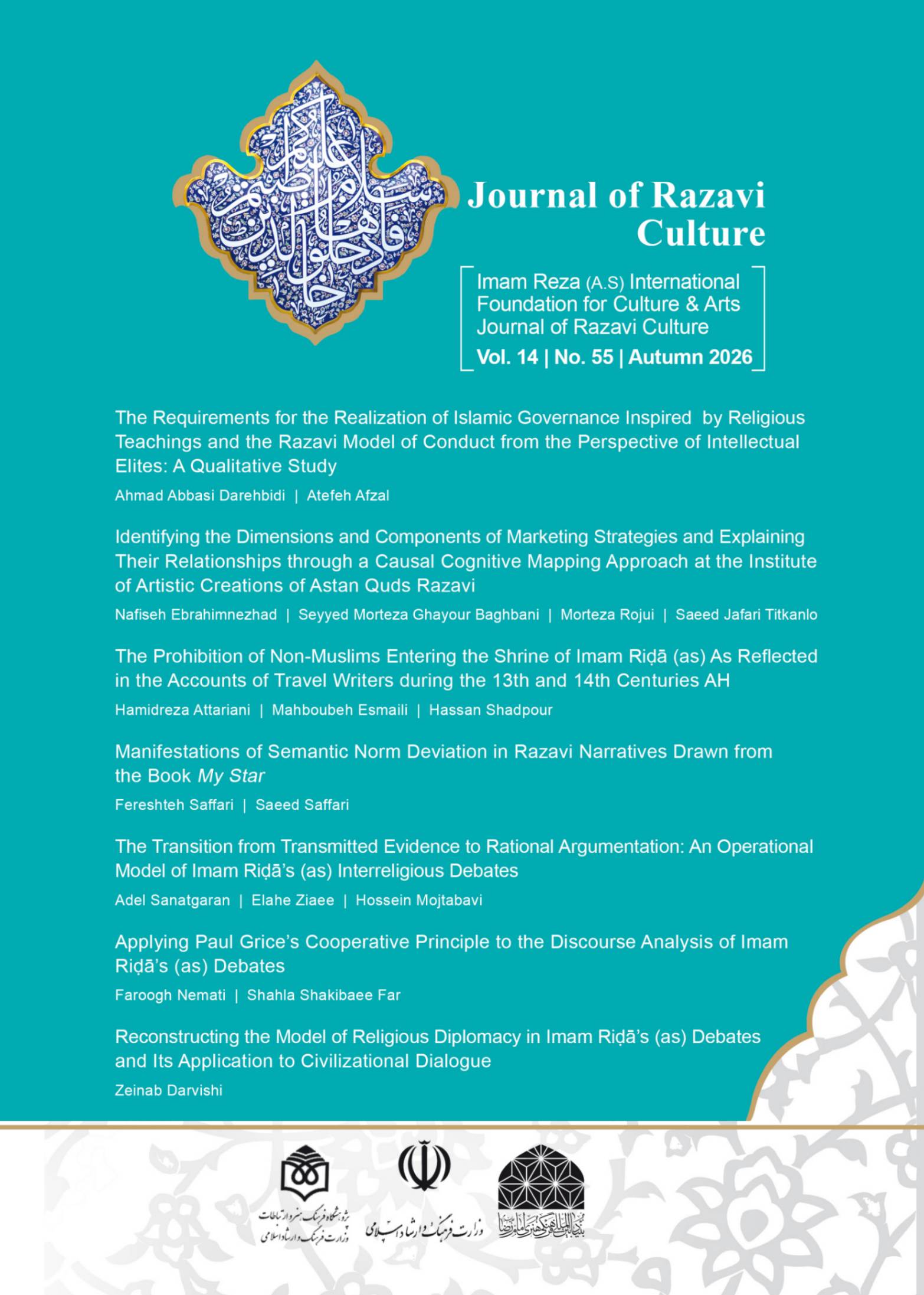
Volume & Issue: Volume 14, Issue 55, Autumn 2026, Pages 7-192 
Number of Articles: 7
Requirements for the realization of Islamic governance inspired by religious teachings and Razavis way of life from the eyes of the elites (a qualitative study)

Requirements for the realization of Islamic governance inspired by religious teachings and Razavi's way of life from the eyes of the elites (a qualitative study)

Pages 7-30

https://doi.org/10.22034/farzv.2024.430306.1952

Ahmad Abbasi Darehbidi, Atefeh Afzal

Abstract The aim of the present research is to identify the requirements and solutions for the realization of Islamic governance based on religious teachings and the Seerah of Imam Reza (AS) using a qualitative study method and a thematic analysis approach. The required information was collected through semi-structured deep interviews and analyzed using the Colaizzian pattern. The study population consisted of knowledgeable elites on the subject, including university professors, seminary scholars, and some Razavi researchers in Isfahan province in 1402, 13 of whom were interviewed based on theoretical and purposive sampling according to the saturation principle. Data analysis led to the extraction of three main themes, including Infrastructure (with three sub-categories of improving social relations, legal and ethical frameworks), Resources and Facilities (with two sub-categories of culture and technology, knowledge and information), and Support and Supervision (with three sub-categories of political-religious and ideological support, financial-credibility and security, and bilateral supervision) accompanied by 48 sub-concepts and 168 general concepts. The examination of the requirements and solutions for the realization of Islamic governance showed that the Seerah of Imam Reza (AS) is rich in political and social concepts and ideas that can provide a basis for the promotion of Islamic governance on one hand,

Identifying the dimensions and components of marketing strategies and explaining their relationships through a causal cognitive mapping approach at the Institute of Artistic Creations of Astan Quds Razavi

Identifying the dimensions and components of marketing strategies and explaining their relationships through a causal cognitive mapping approach at the Institute of Artistic Creations of Astan Quds Razavi

Pages 31-62

https://doi.org/10.22034/farzv.2025.504102.2071

Nafiseh Ebrahimnezhad, Seyed morteza Ghayour baghbani, Morteza Rojuee, saeed jafari titkanloo

Abstract Abstract
Cultural and artistic industries, due to their impact on cultural identity and their crucial role in the creative economy, require effective marketing strategies. Despite the significance of this field, limited research has focused on identifying the dimensions and components of marketing strategies in these industries. Therefore, the main question of this study is: What are the dimensions and components of marketing strategies in the Astan Quds Razavi Institute of Artistic Creations, and how are the relationships between these dimensions structured. This qualitative research was conducted using thematic analysis through coding and causal cognitive mapping with the UCINET software. In the first phase, a review of relevant academic articles from the past ten years was conducted, leading to the selection of 60 articles. Then, in-depth interviews were conducted with eight experts from the institute using purposive sampling. Finally, causal cognitive mapping was employed to explain the relationships among the identified components.The findings revealed a total of 170 basic themes and 40 organizing themes. The marketing strategies at the Astan Quds Razavi Institute of Artistic Creations encompass seven overarching themes: environmental analysis, market segmentation, positioning, targeting, product, pricing, and advertising. Additionally, the relationships among these variables indicate that marketing strategy dimensions are not only significant independently but also interact dynamically, forming a comprehensive and interconnected system. Among them, targeting and environmental analysis have the greatest impact.The proposed model can serve as an effective tool for enhancing marketing efforts in cultural and artistic industries, strengthening the institute’s competitive position in the market.

Prohibition of non-Muslim entry to the shrine of Imam Reza from the point of view of travel writers in the 13th and 14th centuries (A.H.)

Prohibition of non-Muslim entry to the shrine of Imam Reza from the point of view of travel writers in the 13th and 14th centuries (A.H.)

Pages 63-87

https://doi.org/10.22034/farzv.2025.507039.2076

Hamid reza Attariyani, Mahbouba Mahbouba, Hassan Shadpour

Abstract Throughout history, European travel writers and tourists interested in visiting the Razavi Shrine often traveled to Mashhad without knowing the specific rules of the Razavi Shrine and its sanctuaries. During their travels, tourists would ask their Muslim companions, who were on their way to visit the Shrine, They rarely mentioned in their travelogues any reports of their fellow travelers not being accepted, or any complaints or grievances about the regulations for travelers in pilgrimage caravans. However, when they arrived in Mashhad, based on their goals, which were mostly to tour and visit the historical complex of the Holy Shrine, They would encounter an unexpected challenge that would make them tired of the journey. Preventing non-Muslims from visiting the Holy Shrine was a problem during the Qajar and Pahlavi eras, which made European tourists very reluctant to travel to Mashhad. The research method in this study is quantitative and qualitative with a descriptive approach based on events taken from European travelogues in the 13th and 14th centuries AH. This research seeks to find the answer to the question: What measures or reactions did non-Muslim travel writers have in order to create a ban on the Holy Shrine? This research seeks to find the answer to the question: What measures or reactions did non-Muslim travel writers have in order to create a ban on the Holy Shrine? The findings of this study indicate that a large number of them were subject to the legitimate laws and current regulations of the Holy Shrine and public opinion. Therefore, after understanding the limitations, they preferred not to even approach the sanctum sanctorum. Some people also entered the shrine of Imam Reza through legal channels and influence, and a few people have also visited or reported on the holy shrine using subtle tricks and special tricks.

A reflection on the types of non-normative meaning of Razavis stories taken from the book My Star

A reflection on the types of non-normative meaning of Razavi's stories taken from the book "My Star"

Pages 89-110

https://doi.org/10.22034/farzv.2024.435544.1968

fereshte saffari, saeed saffari

Abstract Norm-avoidance or defamiliarization was a term coined by Russian formalists, which was used in order to distance language from vulgarity and common linguistic habits. Semantic norm avoidance with different types of metaphors, similes, permissiveness, sensuality, contradiction, etc. leads its audience from the superficial layers of language to the depths of imagination. In children's and adolescent literature, this process is done by taking into account the age of the audience and their mental and psychological limitations so that the visual and semantic appeal of the linguistic elements does not make understanding the meaning difficult and complicated. It is more important to pay attention to the psychological features of the child and adolescent audience in the works that introduce religious figures. One of these successful works in recent years is the book Setare Man, which explains the most important moral principles of the 8th Imam (AS). The purpose of this descriptive-analytical research is to artistically present the high moral-educational concepts of the 8th Imam (AS) in the form of short stories, which, with the seasoning of fantasy elements, will make the teenage audience stop reading. In this research, by examining the stories, in addition to the moral twists, we have also paid attention to the aesthetic effects of the work and extracted them.The results of the present research indicate that the creator of the work has used the metaphor of the anthropomorphism (anthropomorphism) and sensory similes in the creation of literary images

From Revelation to Reason: The Operational Model of Imam al-Riḍā’s Interreligious Debates

From Revelation to Reason: The Operational Model of Imam al-Riḍā’s Interreligious Debates

Pages 111-137

https://doi.org/10.22034/farzv.2026.589662.2157

adel sanatgaran, elahe ziaee, hossin mojtabavi

Abstract The transfer of Imam al-Riḍā (as) to Marv following his appointment as heir apparent placed him at the heart of a diverse multicultural environment. Within this historical context, and by the initiative of al-Ma’mun’s court, organized debate sessions were regularly convened between prominent representatives of various religions and theologians of diverse sects. The primary objective of this research is to identify the specific operational model and argumentative methodology underlying the Imam’s engagement with this religious diversity. While previous studies have often evaluated these sessions merely from a traditional theological perspective, the present article, utilizing a historical-analytical method based on a comparative reading of historical texts, focuses specifically on the structure and systematic logic of these dialogues. The primary research sources—specifically ʿUyūn Akhbār al-Riḍā, al-Tawḥīd, and al-Iḥtijāj—have been utilized with critical source-based scrutiny. The research findings indicate that these debates were grounded in a coherent operational model of “Jadal-e Ahsan” (better argumentation), the central feature of which is a “methodological gradation from Revelation to Reason.” This model consists of three fundamental components: rational reasoning coupled with a complete avoidance of takfir; compelling the interlocutor through their own sacred texts and accepted epistemological foundations; and maintaining the dignity of the opposing party throughout the debate. A comparative analysis of five landmark debates—with the Catholicos, the Exilarch, the Hirbadh, Imran al-Sabi, and Sulayman al-Marwazi—demonstrates the consistency, coherence, and dynamism of this operational model across vastly different situations. In this process, the Imam began the discourse from a point of textual commonality and, to avoid textual stalemates, elegantly elevated the level of the debate to pure rational proofs. Consequently, this article reconstructs the Riḍawi debates as a systematic historical model for interreligious dialogue.

The Application of Paul Grice’s Cooperative Principle in the Discourse Analysis of the Ridavian Debates

The Application of Paul Grice’s Cooperative Principle in the Discourse Analysis of the Ridavian Debates

Pages 139-167

https://doi.org/10.22034/farzv.2026.579482.2142

faroogh nemati, shahla shakibaee

Abstract The debates of Imam al Ridā (A) with scholars of various religions and sects during the era of al Maʾmūn represent some of the most significant examples of rational dialogue within the Islamic tradition. These debates exhibit systematic methods of reasoning, persuasion, and linguistic interaction management. Examining these exchanges through the lens of applied linguistics can reveal new dimensions of their discursive mechanisms and communicative strategies. The present study aims to explain how Grice’s “Cooperative Principle” is employed in the Ridavian debates and seeks to analyze the ways in which the four conversational maxims—quantity, quality, relation, and manner—are fulfilled or intentionally flouted within these dialogues. The data have been collected from reliable historical and narrational sources reporting the debates, and analyzed using a descriptive analytical approach grounded in Gricean applied discourse analysis. The findings demonstrate that Imam al Ridā’s (A) discourse is largely characterized by strict adherence to the maxims of relation and quality, which contributes to maintaining the logical coherence of the dialogue and enhancing the epistemic credibility of the arguments. At the same time, purposeful violations or suspensions of certain maxims—especially quantity and manner—are observed, functioning rhetorically and argumentatively to generate effective conversational implicatures that reinforce audience persuasion. This indicates that, beyond their theological and doctrinal richness, the Ridavian debates display a deliberate and coherent structure from a linguistic interactional perspective. Based on the results, Grice’s Cooperative Principle provides an efficient analytical framework for examining communicative mechanisms and discursive strategies in Islamic debate texts.Grice’s Cooperative Principle provides an efficient analytical framework for examining communicative mechanisms and discursive strategies in Islamic debate texts.

Reconstructing the model of religious diplomacy in the debates of Imam Reza (AS) and its application in contemporary civilizational dialogue

Reconstructing the model of religious diplomacy in the debates of Imam Reza (AS) and its application in contemporary civilizational dialogue

Pages 169-192

https://doi.org/10.22034/farzv.2026.582933.2146

zeynab darvishi

Abstract In the contemporary era, characterized by the expansion of religious pluralism and increased intercultural interactions, designing effective models for interfaith dialogue has become a central issue in civilizational studies and cultural diplomacy. Despite a significant body of research on interreligious dialogue, the systematic utilization of the capacities within the Islamic tradition in this domain has received limited theoretical attention . The debates of Imam Reza with scholars of various religions and sects during the Abbasid Caliphate under al-Ma’mun exemplify a prominent instance of rational and methodical engagement with doctrinal diversity. However, these debates have often been analyzed merely from theological or historical perspectives, with their civilizational and diplomatic dimensions being less explored.

This research adopts a descriptive-analytical approach and employs qualitative content analysis to extract the components of dialogue diplomacy from the debates of Imam Reza , subsequently reinterpreting them within the theoretical framework of contemporary civilizational dialogue . The findings indicate that the “Rezaian model” is founded upon core principles such as prioritizing shared rationality, argumentation based on the interlocutor’s epistemic foundations, safeguarding human dignity, abstaining from conflict-oriented approaches, and favoring the pursuit of truth over dominance. This study, by presenting an indigenous and operational framework, bridges a gap in the existing theoretical literature and offers an innovative solution for managing contemporary religious and cultural challenges. These components can serve as an indigenous and effective foundation for strengthening religious diplomacy and effectively managing religious tensions in contemporary multi-religious societies, providing a valuable framework for enhancing intercultural and interreligious relations.