Keywords = گفتمان
Number of Articles: 4
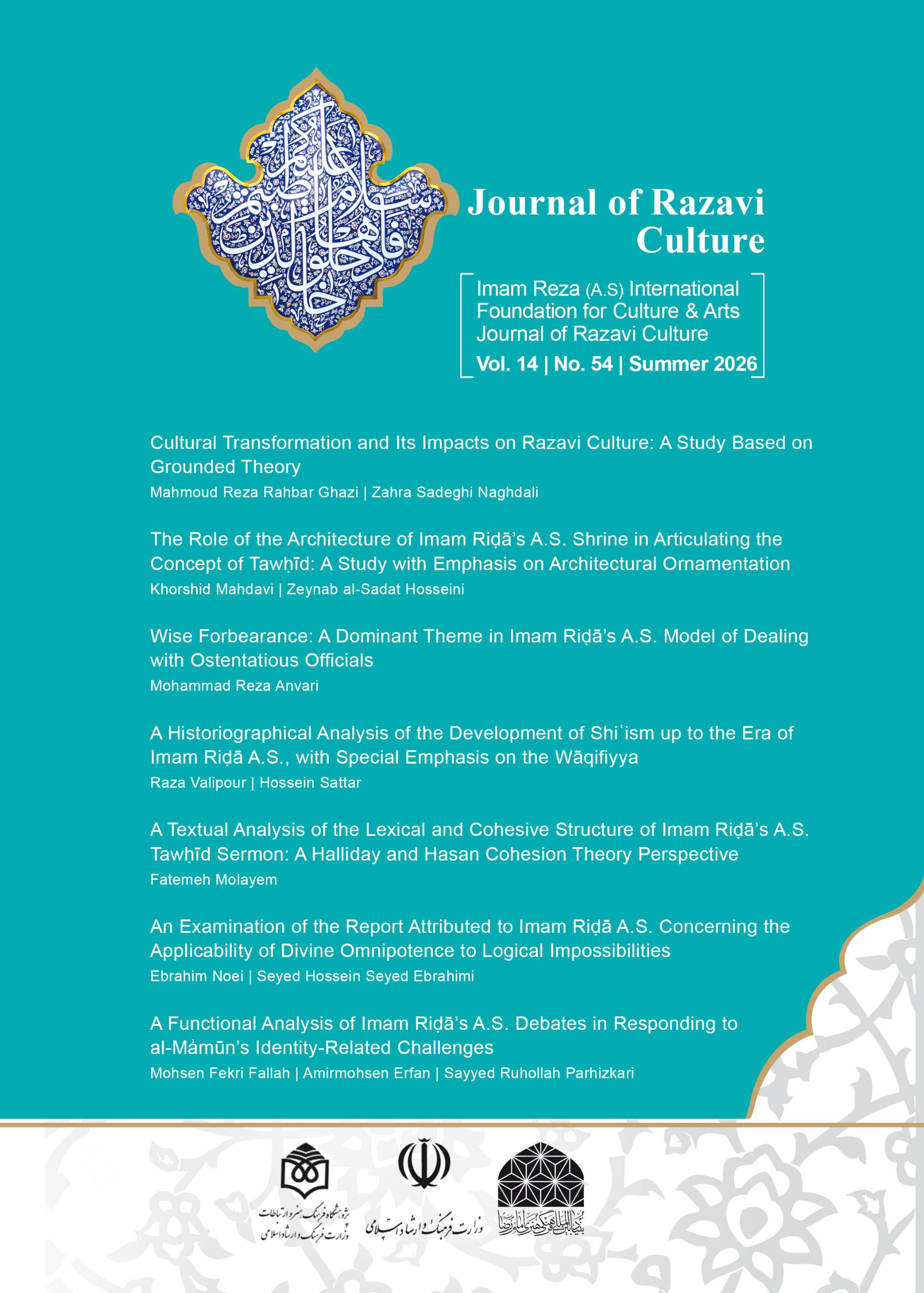
A Historiographical Analysis of the Development of Shiʿism up to the Era of Imam Riḍā A.S., with Special Emphasis on the Wāqifiyya

A Historiographical Analysis of the Development of Shiʿism up to the Era of Imam Riḍā A.S., with Special Emphasis on the Wāqifiyya

Volume 14, Issue 54, Summer 2026, Pages 93-124

https://doi.org/10.22034/farzv.2025.496674.2062

reza valipoor, Hossein Sattar

Abstract This study, employing a conceptual history (History of Ideas) approach, analyzes the emergence of the Waqifah sect within the broader intellectual developments of the Imamiyah up to the time of Imam al-Ridha. Rather than representing a definitive schism, the formation of the Waqifah is interpreted as a product of internal cognitive tensions and evolving ideas regarding leadership, legitimacy, and occultation following the death of Imam al-Kadhim. The study critically reexamines traditional narratives—especially those presented by heresiographers and historians—through the lens of conceptual transformation. It argues that the Waqifah phenomenon was not an external rupture but an internal evolution rooted in diverse interpretations within Imamism. This analysis underscores the importance of rethinking early Shiite sectarianism using modern analytical tools and highlights the contingent, negotiated nature of religious authority in early Shiism.

Analysis of Different Facets of Netizitation and Discursive Conflict in the Process of Acceptance of Viceroy by Imam Riḍā (as)

Analysis of Different Facets of Netizitation and Discursive Conflict in the Process of Acceptance of Viceroy by Imam Riḍā (as)

Volume 7, Issue 27, Autumn 2019, Pages 57-85

https://doi.org/10.22034/farzv.2019.94044

Ali Soleimanpour, Amir Akbari, Mohammad Dareyni

Abstract This article attempts to present and examine some aspects of netilization and the dimensions of the discursive conflict in the process of accepting Imam Reza's viceroy. Since the acceptance of the Supreme Leader by Imam took place in a particular political atmosphere, his extensive efforts to get away from the intellectual, political and social system of the enemy (rival discourse) and its negation is important in linguistic and practical ways. What is certain is that Raḍavī's political discourse, in the context of the general discourse of Imamate and Wilāyat, and influenced by historical and prolonged conflicts over the discourse of "caliphate and monarchy," has shown various aspects of conflict and oppression.
The results of this study show that Raḍavī's discourse has succeeded in expanding its semantic system and political thought in public opinion of the society and becoming a comprehensive discourse (hegemonic). The use of literature and the methodology of discourse analysis, especially the proposed approach by Laclau and Mufa, is a distinguishing feature of this article that has so far been less widely considered and used.

Sign-Semantic Study of the Emotional Discourse System in the case of Raḍavīs Child Pilgrim of ‘Abd al-Jabbār Kākāī

Sign-Semantic Study of the Emotional Discourse System in the case of Raḍavī's Child "Pilgrim" of ‘Abd al-Jabbār Kākāī

Volume 7, Issue 27, Autumn 2019, Pages 171-199

https://doi.org/10.22034/farzv.2019.94048

Mozhgan Mirhoseini, Ebrahim Kanani

Abstract The emotional system is one of the discourses that are studied in the Sign-Semantic. In the emotional way, the interaction between large sets of signs, called forms of expression (sign) and content forms (signifying), fulfills the semantic-signification process. This interaction forms the basis of discussions in this system. This interactive relationship provides the opportunity for scholars to engage in a meaningful process with their perceptual, emotional, and emotional presence. Accordingly, in each discourse we come across different emotional mechanisms that can be studied. In fact, the emotional world is a language that has its own system, and it is the task of semantics, to study the system, and to examine the conditions of its realization and the outburst of meaning. The question that arises is how and under what discourse conditions this linguistic system can be studied. Based on this, The main question of the present study is which of the semantic mechanisms underlying the emotional process in the children of Raḍavī who are the pilgrim of ‘Abd al-Jabbār Kākāī? In addition, what process of realization and abundance of meaning is based on which discourse conditions occur? In fact, the purpose of the present study is to examine the sign-semantics of the emotional system in the discourse of the pilgrims' children in order to find out how meaning is created? The results and findings of the research show that the emotional discourse of pilgrim children is subordinate to the perceptual-sensory, aesthetic, transcendental, tension and physical mechanisms, and is based on a kind of emotional service. This research can be a model for analyzing and reviewing the dominant discourses on the Raḍavī culture and literature in the Raḍavī childhood.

The Thematic Exploration of the Theological Argumentations Based on Imam Reza (A.S)s Doctrine

The Thematic Exploration of the Theological Argumentations Based on Imam Reza (A.S)'s Doctrine

Volume 5, Issue 20, Spring 2018, Pages 189-222

Fereshte Motamad Langrodi, marzieh mohases, Fatemeh Akbarizadeh, Zahra Ghasem Nejad

Abstract The theory of "Argumentation" serves as an aspect of discourse which aims at presenting an argument to bring about an internal influence within the addressees. The process is carried out through the utilization of linguistic elements in discourse. In the present era, one might use this new method of discourse analysis to open up a new way to the authentic heritage of Imam Reza (A.S). In line with the necessities of his time and along with purification of theological discussions, Imam Reza (A.S) adopted an argumentative discourse and a guidance-oriented approach to maximally use the reasoning potential of his addresses. In addition to the scientific explanation of the argumentation theory, the study at hand has set out to answer this question: According to Imam Reza (A.S)'s doctrine, which themes serve as the main axioms of the theological arguments? Regarding the research method, the study has employed a descriptive-analytical approach. Consequently, after specification of the conceptual boundaries of the term argumentation and similar terms such as polemic, sermon, argument and persuasion, the contemporary approaches to this theory are used to categorize the themes of Divine Oneness, Imamate, and Prophecy as the frequent themes of those traditions received from Imam Reza (A.S), based on argumentative discourse. In the eyes of the authors, the Imamate theme – as the most frequent theme in Imam Reza's (A.S) theological arguments – has not only been a necessity of the time, but also an indication of a necessity in Shi'a school and Imam Reza's (A.S) cultural advice on the necessity of equipping the Shi'a with different means to prove the principle of Imamate. In other words, as a result of using this discursive style, the concept of the Imamate of the Prophet's Family (A.S) – as one of the main issues of the Muslim society and the essence of Shi'a school – receives more attention.